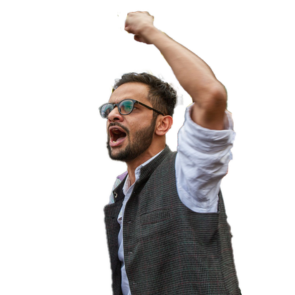
Umar Khalid
Umar Khalid is an Indian human rights defender, historian and student activist who has been held without trial in Delhi's Tihar Jail since September 2020. He is one of the most prominent faces of dissent in India today, and his continued imprisonment has come to symbolise the use of anti-terror laws against those who campaign for pluralism and constitutional values. He faces charges under India's Unlawful Activities (Prevention) Act (UAPA) in connection with communal violence that broke out during protests against the Citizenship Amendment Act (CAA) in February 2020. Six years on, his trial has not yet begun.
Khalid was born and raised in Delhi, in Jamia Nagar, a Muslim-majority neighbourhood in the southeast of the city, where he has said he witnessed how rising Hindu nationalist politics fractured Indian society along religious lines and pushed Muslims further to the margins. He has spoken about how growing up amid that marginalisation made political engagement, for him, unavoidable.
He studied history at Kirori Mal College, University of Delhi, before going on to complete an MA, MPhil and PhD at Jawaharlal Nehru University's Centre for Historical Studies. His MPhil research looked at the rights and history of the tribal communities of Singhbhum, and his doctoral dissertation, submitted in 2018, was titled "Contesting Claims and Contingencies of the Rule on Adivasis of Jharkhand." It examined the history of Adivasi societies in Singhbhum under British colonial rule and their changing relationship with state authority. That research has since been published as a book, Fractured Communities: Adivasi Histories and the Politics of Power, by Juggernaut.
At JNU, a university long known for its left-leaning student politics and its role as a target of right-wing criticism, Khalid was known as a sharp and critical mind, shaped by a campus culture that valued critical thinking and a commitment to the marginalised. Those who knew him at the time describe him as someone far from career-minded, who spoke up consistently on the rights of Adivasis, the dignity and rights of Dalits, the concerns of minorities, and the rights of workers and farmers, and against communalism in all its forms.
In February 2016, Khalid and several other JNU students were arrested and charged with sedition after a political event on campus marking the anniversary of the 2013 execution of Afzal Guru, organised in part as a protest against capital punishment, and spent 24 days in custody. The case and the government's use of sedition charges against university students turned him into a prominent, and controversial, symbol in the national debate over dissent and nationalism. He was rusticated from JNU for a semester as a result, and Indian television channels branded him an "anti-national," which Khalid has said permanently changed the course of his life. The university subsequently refused to accept his completed doctoral thesis, he challenged that decision in the Delhi High Court and won, finally submitting his PhD in 2018.
In 2017, Khalid became one of the public faces of United Against Hate, a civil society initiative set up in response to a wave of lynchings and communal violence, working through fact-finding missions, public campaigns and awareness drives. His activism at this stage increasingly focused on minority rights, resistance to communal discrimination, and the defence of India's constitutional values. These are concerns that ran alongside, and were shaped by, his academic interest in the histories of communities whose voices he believed had long been pushed to the margins of power.
He had already faced direct threats to his safety before his 2020 arrest. In August 2018, while attending an event called "Khauf Se Azaadi" ("Freedom from Fear") near the Constitution Club in Delhi, a gunman opened fire at him. He was unharmed. The attack came after he had reportedly received death threats and sought police protection.
In late 2019 and into 2020, Khalid became one of the most visible speakers in the nationwide movement against the CAA and the proposed National Register of Citizens (NRC), travelling widely and addressing public meetings across the country. He argued that citizenship should never be determined by religion, and that the CAA-NRC framework violates the constitutional principle of equal citizenship. His speeches during this period drew heavily on the Constitution, on the history of India's freedom struggle, and on the lived experience of marginalised communities. He was outspoken in his criticism of what he saw as an attempt to redefine Indian citizenship along religious lines, and to remake India as a Hindu-majoritarian state.
Communal violence broke out in northeast Delhi in February 2020, in the midst of the CAA protests and following Delhi's legislative assembly elections, fuelled in part by online misinformation and inflammatory rhetoric from figures aligned with the ruling party. Hindu mobs targeted Muslim residents, mosques, and people identified by name or by physical markers of religious identity, in response, some Muslims retaliated. Over three days, 53 people were killed, most of them Muslim, and hundreds more were injured.
When Delhi Police brought charges over the violence, they named no figures from the ruling party and very few of the Hindu participants. Khalid, who was roughly 1,000 miles from Delhi when the riots broke out, was instead accused, along with more than a dozen other human rights defenders and student activists, of "masterminding" and "engineering" the violence as part of a coordinated conspiracy against the state. Investigators leaned heavily on his public speeches to build terrorism and conspiracy charges, treating explicitly non-violent language calling for solidarity as evidence of an armed plot.
Khalid was arrested on 13 September 2020 at his family's home in Delhi, in connection with the police investigation into the February violence. The prosecution's case relies significantly on a speech he gave in Amravati, Maharashtra, on 17 February 2020, in which he used the phrases "inquilabi salaam" (revolutionary salute) and "krantikari istiqbal" (revolutionary welcome) while praising the crowd for dissenting peacefully against the CAA, language that amounts to protected speech under international human rights standards, not incitement. Prosecutors allege the speech was part of a broader plan to cause disruption and violence to coincide with then US President Donald Trump's visit to India later that month, and that Khalid went on to help coordinate protests and road blockades as part of that plan. Khalid denies the allegations, and his supporters, along with a number of civil society organisations, have described the case as an attempt to criminalise peaceful anti-CAA activism and, more broadly, political dissent.
He was charged under the Indian Penal Code with offences including sedition, unlawful assembly, promoting enmity between religious groups, murder and attempted murder, along with charges under Sections 13, 16, 17 and 18 of the UAPA covering unlawful activities, terrorist acts, raising funds for terrorist acts and conspiracy, as well as charges under India's Arms Act.
In December 2022, a Delhi court acquitted Khalid in a separate case involving rioting and property damage. He has nonetheless remained in custody in the broader UAPA "larger conspiracy" case, alongside several co-defendants, while the investigation and pre-trial proceedings continue with no end in sight.
His bail applications have been turned down again and again. On 2 September 2025, the Delhi High Court described five years of pre-trial detention as the "natural pace" of proceedings, despite the trial still not having begun. On 5 January 2026, the Supreme Court acknowledged the considerable delay in bringing the case to trial, but declined to grant Khalid regular bail, citing the seriousness of the allegations and the material placed before it, and barred him from filing a fresh bail application for a year. In the same judgment, the Court granted bail to several of his co-defendants, among them Gulfisha Fatima, Shifa Ur Rehman and Meeran Haider, leaving Khalid alone among the group still behind bars. Even for those released, the underlying cases remain open, with no trial date set, a reminder that release from custody has not meant an end to the legal jeopardy, or to the broader pattern of persecution.
On 30 June 2026, Khalid gave his first public statement since his arrest, relayed through family and friends to a journalist because prison conditions ruled out a direct meeting. He described the psychological and physical toll of nearly six years of pre-trial detention, and the strange experience of being reduced, in the public eye, to a flattened image, either vilified or held up as a hero, in a way that erases his own ordinary human vulnerabilities. He said the years in custody have taken a real toll on his mental and physical health.
None of that appears to have dulled his convictions. Khalid has spoken of his alarm at the growing normalisation of hate speech in Indian public life, and of how the repeated delays, adjournments and recusals in his bail hearings have worn him down, describing the slow erosion of hope as among the hardest parts of being in prison.
Those following his case closely see his continued imprisonment as evidence of a wider moment in India: the expanding use of anti-terror laws against dissent, the role of a compliant media in shaping public perception long before any trial takes place, and a pattern, documented across a number of UAPA cases, in which overbroad terrorism definitions and restrictive bail provisions function as a form of punishment before, or entirely without, a conviction. That pattern disproportionately affects human rights defenders, journalists and students who exercise their right to peaceful assembly and free expression.
In September 2025, ahead of the five-year anniversary of his arrest, Front Line Defenders joined Amnesty International, CIVICUS, FORUM-ASIA, the International Commission of Jurists, FIDH and OMCT in publicly calling for Khalid's immediate and unconditional release, for bail standards to be applied equally regardless of who is accused, for accountability for those actually responsible for the 2020 violence, and for reform or repeal of the UAPA.

