Human Rights Defender Cheri Honkala
“While freedom and democracy are celebrated today, the poor still live in terror, with no right to healthcare, food, affordable housing, or a job at a living wage. They are trying to drown out our voices, but we will be heard” – Cheri Honkala
Cheri Honkala is the executive director of the Kensington Welfare Rights Union (KWRU), a mother, teacher, and social worker. She has been homeless three times and until four years ago was a welfare recipient.
Based in Philadelphia, the Kensington Welfare Rights Union is a non-violent, multi-racial organization of poor and homeless families. For twelve years it has been developing leaders from among the ranks of the poor and fighting to secure basic human needs for poor men, women, and children in the United States.
Honkala has been arrested over eighty times. She has faced four felony charges carrying a potential for twenty years in prison. Repercussions for Honkala’s activities have also been visited upon her son. At the age of 13, he was arrested at a homeless demonstration. He was stripped and subjected to an intrusive body-cavity search. He subsequently filed a lawsuit against the city that led to a change in the law to prevent such searches.
On US Independence Day, July 4, 2003, the city of Philadelphia held a celebration for the opening of Constitution Center, a new facility housing the Liberty Bell, a venerated symbol of the American Revolution. Poor and homeless families from Philadelphia planned to take advantage of the event by holding a peaceful protest to demand their economic human rights.
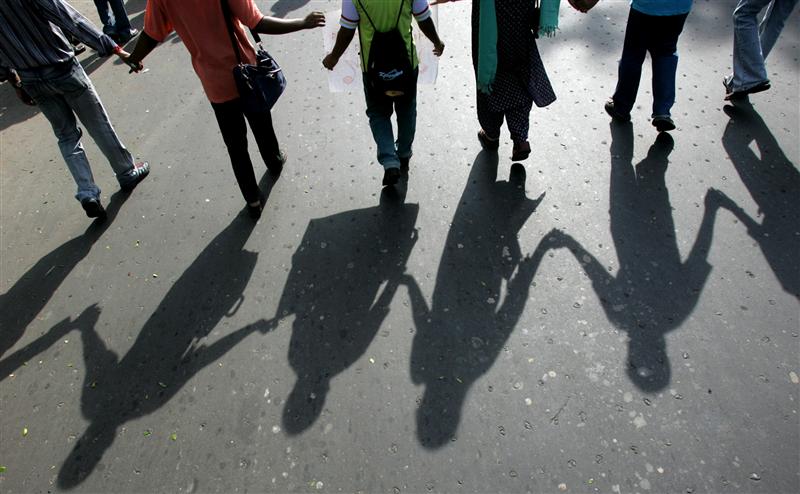
As the demonstrators marched toward Constitution Center single-file, carrying their own mattresses and led by children, park rangers, federal guards, and city police formed lines to prevent the families from approaching. Singing “We Shall Not Be Moved”, the demonstrators locked arms and refused to leave the sidewalk.
Protest leaders Honkala and Galen Tyler had prepared a “Declaration of Economic Human Rights” to present at the Center. As they moved toward the Center, police moved to stop them, threw them to the ground, handcuffed them, and placed them under arrest. Honkala and Galen spent the night in jail, charged with multiple felony and misdemeanor offenses, including disorderly conduct, resisting arrest, and assaulting a police officer.
Honkala was charged with one first-degree felony and four other felony counts. Police officers claimed that Honkala had struck one of them in the chest. However, a video taken at the time clearly shows Honkala carrying a mattress and being struck by the officer. In subsequent hearings, it became clear that a whole room full of police officers conspired to concoct charges against Honkala and Tyler, but all the charges were subsequently withdrawn by the District Attorney’s office.
- * *
Cheri Honkala grew up poor in Minneapolis, Minnesota. Her mother, a victim of domestic violence and abuse, was classified as an unfit parent. From the age of 13, Honkala was placed in nine different juvenile institutions. At 16, she says she became pregnant as a way of avoiding more institutions.
She persuaded a car dealer to sell her a car; she lived in it while pregnant. When she lost the car, she could not find shelter in the winter. Forced to move from one short-term place to another, she still managed to complete high school. She got a job and lost it. She began living in abandoned, unheated structures until her first son was born in 1981. After that it became too frightening to continue to find vacant housing on her own, so she teamed up with other women she met in a welfare office. Thus, she says, her work with homeless families began as a matter of personal necessity.
As she became more aware of the political dimensions of her personal situation, she began to see more and more people living in similar conditions. Seeing so many people getting “kicked around” so often, she began to ask herself, “How do they [official authorities] get away with it?” The more organizations she went to for assistance, the more she heard that homelessness “is not our issue”. Honkala describes herself in those years as having a hard time understanding how so much money could be spent on the military and so little on the needs of the homeless.
In the late 1980s, Honkala became a key activist with Up and Out of Poverty Now, an organization based in Minneapolis that took over vacant buildings to be used as housing for homeless families. Eventually, Honkala was given space in the Minneapolis office of Women Against Military Madness, and began merging her personal and political concerns.
As a result of her political activity, she was ultimately prevented from obtaining housing in Minneapolis. When a relationship developed with a union official in Philadelphia, she decided to marry and move there with her young son. They settled in the Kensington neighborhood, the origin of the famous march in which the famous union organizer Mother Jones led a group of children who had lost fingers in industrial accidents to New York to protest the treatment of children used to fill industrial jobs.
Like many inner city neighborhoods in the USA, Kensington has always had a difficult time of it. Kensington’s decline began with the loss of textile and brewing jobs to cheap labor pools overseas. Poverty and homelessness rose. Galen Tyler, chair of KWRU’s Organizing Committee, says, “Welfare and drugs are the two biggest sources of incomes in Kensington”.
In Philadelphia Honkala became a juvenile social worker. When she protested inadequacies in the treatment of a particular case, she was laid off. When she found herself again poor, without a job, and with the responsibility for a young son, she had to turn to welfare.
However, she refused to sign the Pennsylvania Agreement of Mutual Responsibility (AMR) because it essentially absolved the state of responsibility for childcare, health care, and employment assistance for parents who were receiving welfare. As a consequence, she was permanently sanctioned from receiving cash assistance from the welfare authorities. In 1991 along with five other women, Cheri Honkala founded the Kensington Welfare Rights Union in the basement of a church. She says that she simply needed to join with other women to prevent her own homelessness, but this personal survival effort soon became a movement on behalf of all poor and homeless people.
Honkala sums up her work and her life this way:
The reality is I miss a normal life, whatever that is. I’m not a martyr. There’s very little romanticism about this work. I would love to go on vacation, I would love to go shopping, buy my son things, and I’d love to have paid my rent for the last two months. However, I think that there are many fundamental things that happened to me in my life that knocked me so down, from growing up and being taken away from my mother to pulling myself up by my bootstraps in this country and then becoming homeless with my son, and then burying tons and tons of people as a direct result of being poor. Those are the things that really make me who I am, and give me strength to not take the easy way out. Actually, it really wouldn’t work for me. I think that once you have your eyes opened, and you see what’s happening in this world…for me I can’t go back. I might be able to handle working in one of those kinds of jobs for maybe a few weeks or whatever, but I would go insane. There’s something deeper that I would lose in that process. Right now, I may not have any money. However, I sleep well at night, and I can get up every morning and feel good about who I am. I really feel like I’m totally alive. I think that even though I don’t have money, I have something that a whole lot of people strive their whole life for, which is to live life to the fullest.
- * *
In 1991 the Kensington Welfare Rights Union took over an abandoned welfare office where drugs were being sold. They cleaned it up to create a community center for the children of homeless parents. They were arrested and charged with fifteen counts carrying the potential for fifteen years in prison; they were acquitted.
KWRU developed a constant commitment to salvaging excess housing in Philadelphia in order to provide shelter for homeless families. Honkala points out that while there is little affordable housing in Philadelphia, there is more abandoned housing than there are homeless families. KWRU has emphasized the acquisition of vacant government-owned housing and the resettling of homeless pregnant women and families.
Such activity is illegal, even when buildings are apparently permanently abandoned. Honkala and her colleagues are arrested over and over, and then negotiate for their release and for use of the properties. In this way they have secured over five hundred properties for use by homeless residents.
Honkala says, “There’s no reason for hunger and homelessness. They can put up stadiums and entertainment centers – they can build houses too”.
The main actions of KWRU follow a pattern: they identify an abandoned property, usually owned by the Department of Housing and Urban Development (HUD). They move homeless families into the property. The police arrive, sometimes within hours, sometimes as long as two years later. Depending on whether the housing is owned by the municipal or Federal Government, any one of a number of law-enforcement agencies may be involved: local police, federal marshals, the Federal Bureau of Investigation (FBI), or the Office of Civil Affairs, an agency of the Philadelphia police that monitors and investigates local groups, similar to the FBI’s national role. KWRU fills the house with students, religious leaders, and community activists willing to be arrested for the cause and committed to non-violent civil disobedience. Sometimes there is no action at all; sometimes everyone goes to jail for days. The variation seems to reflect the prevailing political expediency of the moment. Sometimes the families are resettled in other housing, either by city or federal housing authorities, or by private donors.
KWRU also sets up homeless encampments. They identify a plot of vacant land at a spot that will be sure to draw attention. They erect shantytowns of sixty or more homeless families and name them after prominent officials responsible for perpetuating poverty. They have also taken over abandoned churches and been arrested in the company of nuns.
Honkala describes KWRU’s actions this way:
Daily we're engaged in using what we call our "human rights house" right now to make plans on where the abandoned houses are in the Philadelphia area. We take poor and homeless families through the training on how to do a take-over. We identify abandoned properties that are owned by Housing and Urban Development [the Federal housing agency], and we go out to the properties. We move the families in, and the families usually live there from anywhere from four to six months. There's usually a great deal of police activity during those four to six months, but we know that those properties are under the jurisdiction of the Federal Government, and that they have to send out Federal Marshals in order to evict families from those properties. We do it because we feel like we're morally justified, that if the City of Philadelphia can't house these families then we intend to house them ourselves….What would it be like to live in a cooperative society? And we try to demonstrate that, and live that every day of our lives, through free food distribution. Where food would normally be thrown away, we distributed it. Where empty houses would remain empty, we try and fill those houses. So, we try to live cooperatively and model our everyday lives after a much larger vision of a new kind of world that we'd like to live in.
In August of 1996, then President Clinton signed “welfare reform” into law, essentially removing the federal safety net for poor people that had been in place for over sixty years. Under the Temporary Assistance to Needy Families (TANF) reform plan, all “able-bodied” welfare recipients are required to work at least twenty hours a week in order to receive benefits, a system similar to what had been known as “workfare”. In practice, for most people who receive assistance this means wages at or below minimum wage, with no benefits and without the basic safety, health, and civil rights protections other employees are guaranteed. Workers are rarely able to unionize and are sometimes used to replace union workers.
In response Cheri Honkala and other members of the Kensington Welfare Rights Union intensified their efforts to make poverty a human rights issue, not just in Philadelphia but across the country. Their strategies included highly visible marches, national tours, and tent encampments. In July 1997, KWRU organized the March for Our Lives from the Liberty Bell in Philadelphia to the United Nations in New York to protest human rights violations in the USA caused by welfare reform. This event served as the launch of the Poor People’s Economic Human Rights Campaign, initiated by KWRU and linking over one hundred organizations of poor people from across the USA. Honkala said,
Those of us who have slept on the sidewalks can see the numbers [of homeless] growing. The fastest growing segment of the homeless in the US is families with children. Families who must go daily and wait in line from early morning until six at night, praying and hoping that the shelter provider calls out their name. Meaning they and their children have been chosen for the few remaining beds for that night.
In the summer of 1999, KWRU led a series of housing takeovers and set up tent cities to address a growing crisis of affordable housing and poverty in Philadelphia. After being charged with multiple felonies for attempting to rehabilitate abandoned houses and being ejected from Independence Mall near the Liberty Bell, they set up “Clintonville”, a tent city where families lived until they could secure affordable housing.
Other marches followed. In October 1999, KWRU led organizations of the poor and homeless from across the USA, as well as Canada and Latin America, on a “March of the Americas” from Washington, DC, to the United Nations in New York to protest economic human rights violations. Another march in July of 2000 drew 10,000 homeless and poor people from around the country for the opening day of the Republican Party’s National Convention in Philadelphia. Of several protest marches, this "March for Economic Human Rights” was the only one denied a permit by city authorities. From November 10 to December 10, 2002, the Poor People’s Economic Rights Campaign organized a second national bus tour of the USA. Poor, unemployed, and working families traveled across the country to document and protest economic human rights violations.
Following the disrupted July 4, 2003, demonstration in Philadelphia, KWRU led the Poor People’s Economic Human Rights Campaign on an epic march from Marks, Mississippi to Washington, DC. Timed to commemorate the thirty-fifth anniversary of the Poor People’s Campaign that Dr. Martin Luther King was planning when he was assassinated, they arrived in Washington on the fortieth anniversary of King’s “I Have a Dream” speech. The marchers called upon the memory of Dr. King, who once asked, “What does it profit a man to be able to eat at an integrated lunch counter if he doesn’t have enough money to buy a hamburger?” The marchers erected an encampment on the National Mall they dubbed “Bushville”. Honkala and other march leaders were arrested the day they arrived and held for two days. They were banned from setting foot on the Mall on threat of six months in jail.
And KWRU continues to march. They are preparing to lead a massive poor people’s march on the first day of the Republican National Convention in New York City, in September of 2004.
In June of 1998 KWRU organized its first national bus tour. New Freedom Bus Tour traveled across the United States, gathering stories of economic human rights violations to present to the United Nations. Poor and homeless families visited thirty-five poor urban and rural communities. Says Honkala, “We turned ourselves into human rights monitors and began to document hidden stories of economic human rights violations”. A second bus tour, the Poor People’s Economic Human Rights Campaign, followed in late November, 2002, carrying unemployed and working families to twenty-seven cities to document and protest economic human rights violations.
Through all of these national events, KWRU has continued its day-to-day work in Philadelphia. They have established several “Human Rights Houses”, which serve as bases for education and organizing. They house families, distribute food and clothing, and respond to the needs of poor people in the community. They have set up a “Human Rights Center” in Kensington that offers literacy and leadership classes, political education, and welfare advocacy. Honkala and the KWRU continue to move homeless families into abandoned houses. They teach similar tactics to homeless and poor activists throughout the USA.
As a result of these activities, law-enforcement authorities from around the country view Honkala as a threat to business as usual. When a major event occurs anywhere in the USA that has anything to do with economic rights, Honkala is likely to be subjected to pre-emptive arrest. At the time of the demonstrations against the World Trade Organization (WTO) meeting in Seattle in 2002, Honkala was the first person to be arrested. (Seattle is 3,000 miles from Philadelphia.) Again she was charged with assaulting an officer, charges that were dropped.
The behavior of the Philadelphia police at peaceful demonstrations and events like those of KWRU has long been the subject of criticism and investigation. Such behavior is marked by the following characteristics: 1) pre-emptive arrests of potential leaders or participants; 2) erecting blockades to prevent demonstrators from taking up positions for which they have received permits; 3) unnecessarily aggressive behavior, including taunting, insults, pushing, and beating; 4) those arrested are given unusually high bail fees; 5) rather than receiving the customary citation, demonstrators are held for relatively long periods (e.g. two days) in poor conditions; 6) at interrogation, police use questions about the highly controversial Philadelphia death-row inmate Mumia Abu-Jamal as a political litmus test.
In a move that Honkala views as attempted suborning of her work, the Mayor of Philadelphia offered Honkala a job that would have paid her in excess of $100,000 per year to oversee homeless programs. She turned it down.
When charged as a result of their activities, Honkala and her colleagues are frequently unable to secure legal representation. Depending on the political climate, law firms and individual defenders are intimidated from taking cases related to her work.
The charges currently pending against Honkala include a trespass charge for setting up a “Naftaville” shanty town at a factory in North Carolina that had lost 4500 jobs to other countries as a consequence of the North American Free Trade Agreement; she is also charged with trespass and disorderly conduct in consequence of two separate arrests on the National Mall in Washington DC.
KWRU has filed a lawsuit against the Philadelphia Police Department as a result of the arrests of Honkala and Tyler on July 4, 2000.
Honkala and her colleagues consciously use the Universal Declaration of Human Rights as an international tool, especially its protections and guarantees of international economic, social, and cultural rights. Honkala traces their recognition of their human rights to a cold night in October of 1995, when she and other homeless people were living on the steps of the state capitol building in Harrisburg, Pennsylvania. The Governor, Tom Ridge (now President Bush’s Secretary of Homeland Security), ordered guards to remove the protesters’ blankets. The people on the steps began talking about feeling less than human; this led to a discussion of how much they needed to be accorded basic rights as human beings. This in turn led activists to explore international human rights law, and to reach out to the international community. Honkala has said,
We see this growing poverty as a direct violation of Articles 23, 25, and 26 of the Universal Declaration of Human Rights, and Section 1, Paragraph 30 of the Vienna Declaration and Program of Action regarding ‘Poverty, hunger and other denials of economic, social and cultural rights’.
From April 12 to 16, 2004, Honkala was the only US delegate in an emergency delegation of human rights defenders from the Americas to Venezuela. The delegation’s intent was to protect the human rights advances in Venezuela in health care, housing and education, threatened by foreign and domestic forces seeking to undermine the Government. Said Honkala, “I believe in democracy, nonviolence, freedom of the press, freedom of speech and basic human rights, and I am disturbed by the dismantling of those principles both in my own country and abroad”.
- * *
The United Nations Declaration on Human Rights Defenders states in Article 1 that “everyone has the right, individually and in association with others, to promote and to strive for the protection and realization of human rights and fundamental freedoms at the national and international levels”. Article 2 states that
Each State has a prime responsibility and duty to protect, promote and implement all human rights and fundamental freedoms, inter alia, by adopting such steps as may be necessary to create all conditions necessary in the social, economic, political and other fields, as well as the legal guarantees required to ensure that all persons under its jurisdiction, individually and in association with others, are able to enjoy all those rights and freedoms in practice (emphasis added).
Article 12 of the Declaration further states “everyone has the right, individually and in association with others, to participate in peaceful activities against violations of human rights and fundamental freedoms”.
KWRU not only works in the name of international human rights standards, but also relies on international solidarity to survive. Honkala is convinced that were it not for KWRU’s website being accessed by activists in other parts of the world, the Government would have eliminated KWRU by now. Even so, Honkala believes that within two years she will be serving a long prison term as a consequence for her activism.
Honkala is convinced that the system of controls available to the US Government is far less visible and in some ways more intimidating than methods of repression used by governments more frequently sanctioned by the international community.
Honkala fears the consequences for the movement for economic justice in the USA will fail unless some combination of the following occurs: 1) the movement for economic justice in the USA receives the spotlight of concern from outside the US; 2) human rights monitors are dispatched to the USA to protect the poor, homeless and related activists; 3) an urgent alert system is devised to draw condemnation from other countries when a violation occurs in the USA; 4) there is a concerted challenge to the perception, widespread in the world, that the USA basks in civil liberties.
Honkala believes that there is an urgent need for international human rights monitors to be present at poverty-related demonstrations, marches, and events in the USA. She says there is also a need for international observation of hearings and trials, especially when defendants have been unable to secure adequate legal representation.
Says Honkala, “The more visible we are in the world the safer we are. We’re not very safe right now”.